Health writer DéShond G Barnes has launched a new book "Counteract the Junk: How Research Shows That Fiber Can Counteract the Physiological Effects of Saturated Fat, Calories and Other Junk Food Components - A Flexible Anti-Diet Approach to Staying Healthy" (ISBN: 979-8245516394).
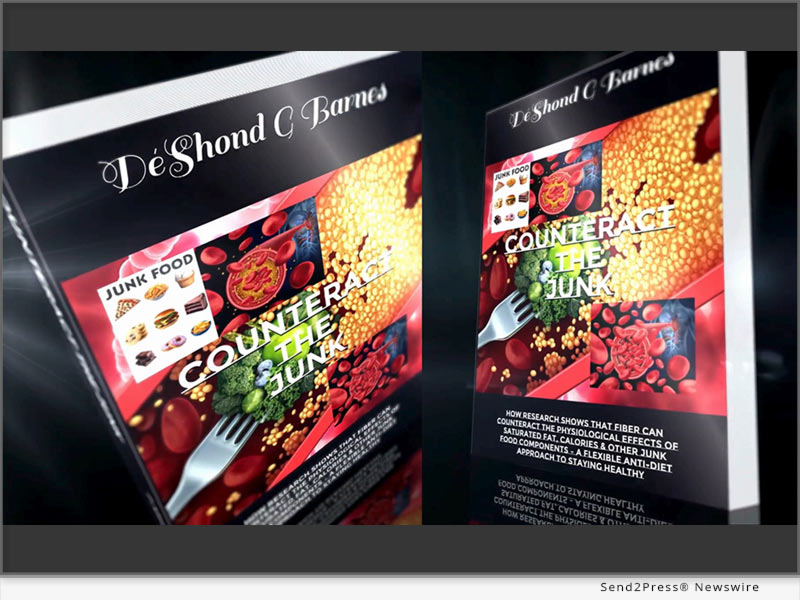
Health writer DéShond G Barnes has launched a new book "Counteract the Junk: How Research Shows That Fiber Can Counteract the Physiological Effects of Saturated Fat, Calories and Other Junk Food Components - A Flexible Anti-Diet Approach to Staying Healthy" (ISBN: 979-8245516394).
Research in health and medicine published in scientific journals has shown over time that a sufficient daily recommended intake of fiber, antioxidants and other essential nutrients from fruits, vegetables, whole grains, beans and other health foods - and to a lesser extent from dietary supplements - can mitigate the health risks associated with junk food by counteracting the physiological effects of saturated fat, calories and other potentially harmful components and effects of junk food.
This means that healthy individuals can now maintain healthy cholesterol and body weight, and reduce their risk of chronic diseases with less restriction and greater dietary flexibility - including the freedom to include budget-friendly, longer-lasting ultra-processed foods in their daily diets. These discoveries are uncovered in "Counteract the Junk." Such discoveries include the following:
CHOLESTEROL AND WEIGHT CONTROL
High-fat junk foods such as cake, ice cream, doughnuts, cookies and pies produce cholesterol-related acids that can clog arteries and raise cholesterol levels over time - opening the door to heart disease. Scientists have identified a special type of soluble fiber found in whole grain oats known as beta glucans that can counteract that effect. According to scientists, beta glucans can remarkably reduce the absorption of dietary fats and control cholesterol and weight by itself, even when added to a diet that includes high-fat foods. Scientists have reported that beta glucans nab cholesterol-related acids produced by dietary fats - ushering them out of the body before they can ravage the heart and arteries and thus lowering the risk of heart disease.
The excess calories in high-fat foods are absorbed by the body and stored as fat, and can cause weight gain over time - opening the door to obesity. Both fiber and antioxidants can counteract that effect. Scientists have reported that fiber helps control weight by reducing the amount of calories the body absorbs. It does that by nabbing calories - speeding them through the digestive system before they can be absorbed and stored as fat. Scientists have also reported that antioxidants help control weight by providing the body with the energy needed to burn fat more efficiently. These actions reduce the likelihood of weight gain and thus lower the risk of obesity.
NITROSAMINES AND PANCREATIC CANCER
Ultra-processed meats such as hot dogs, bacon and sausages contain nitrites. Over time, nitrites can open the door to pancreatic cancer by breaking down and combining with amines to form cancer-causing compounds known as nitrosamines. Vitamins C, E and selenium can counteract that effect. Scientists have reported that vitamins C, E and selenium fight pancreatic cancer by neutralizing nitrites and inhibiting the formation of nitrosamines over time - thus helping to immobilize the cancer-causing process.
HOMOCYSTEINE AND HEART DISEASE
Animal protein foods such as steaks, burgers and ribs can open the door to heart disease and stroke by increasing the body's production of a potentially dangerous amino acid known as homocysteine. Homocysteine is a by-product of protein metabolism. Excessive amounts of homocysteine in the bloodstream open the door to heart disease and stroke by injuring blood vessels, which leads to the buildup of plaque (scar tissue) and narrowing of the carotid arteries. The B vitamins folic acid, vitamin B6 and vitamin B12 can counteract that effect. Scientists have reported that folic acid, vitamin B6 and vitamin B12 fight heart disease and stroke by breaking down excess homocysteine into harmless compounds - thus inhibiting injury to blood vessels and narrowing of the carotid arteries.
This research goes as far back as the 1990s and has been conducted at various research centers and institutions across America and abroad over the decades. Complimentary review copies of "Counteract the Junk" will be sent to journalists, editors and other members of the media upon request.
ABOUT THE AUTHOR
Health writer DéShond G Barnes discovered the "Counteract the Junk" concept in the late 1990s by poring through medical journals and health, nutrition and diet publications for nearly a year, and has practiced the revolutionary "Counteract the Junk" methodology ever since - with incredible success.
By examining nutrition facts labels, calculating the total amount of fiber, antioxidants and other essential nutrients provided by health foods, and consuming a daily diet containing an average of 100+% of the Recommended Daily Allowance for fiber, antioxidants and other essential nutrients - Barnes has maintained excellent blood cholesterol, blood sugar, blood pressure and body weight over the decades without sacrificing unhealthy junk food favorites.
This has inspired Barnes to share this methodology with the rest of the world by publishing "Counteract the Junk" more than two decades later. Barnes also periodically conducts "Counteract the Junk" seminars at local Y.M.C.A.s in northern Illinois to spread the word about the "Counteract the Junk" methodology. Barnes lives and writes in northern Illinois.
ORIGINAL SOURCES
* Donald L. Brown. Antioxidants and cancer prevention: the epidemiologic evidence. American Journal of Clinical Nutrition, 1998.
* Editors of Prevention(r). Prevention's Healing With Vitamins. Rodale Press, Inc., 1996.
* James Gordon. Vegetables, fruit and cancer prevention: a review. Journal of the American Medical Association, 1999.
* Judy Jameson. Fat-Burning Foods and Other Weight-Loss Secrets. NTC/Contemporary Publishing Group, Inc., 1994.
* Mark Bricklin. Prevention Magazine's Nutrition Advisor. Rodale Press, Inc., 1993.
* Michael Murray. Long-term intake of dietary fiber and decreased risk of coronary heart disease. New England Journal of Medicine, 1999.
* Robert Garrison Jr., M.A., R.Ph. and Elizabeth Somer, M.A., R.D. The Nutrition Desk Reference. Keats Publishing, Inc., 1995.
* Selene Yeager and the Editors of Prevention. Prevention's New Foods For Healing. Rodale Press, Inc., 1999.
For additional information about the book, visit https://www.Amazon.com/Counteract-Junk-Physiological-Saturated-Components/dp/B0GJRC5G13.
Related link: https://a.co/d/0dwQ4wf8
This version of news story was published on and is Copr. © Advertising Industry Newswire™ (AdvertisingIndustryNewswire.com) - part of the Neotrope® News Network, USA - all rights reserved. Information is believed accurate but is not guaranteed. For questions about the above news, contact the company/org/person noted in the text and NOT this website.